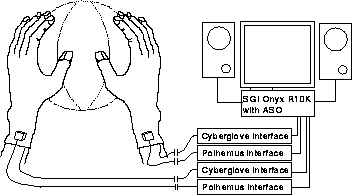
We are using Max/FTS [5] on an R10000 SGI Onyx with audio/serial option (6 serial ports) to interface two Virtual Technologies Cybergloves (instrumented gloves that measure hand shape - see also [4]) and a Polhemus Fastrak (a sensor for measuring position and orientation of a physical object, such as the human hand, relative to a fixed point). Figure 1 illustrates the hardware device setup. While the Cyberglove is probably one of the most accurate means to register human hand movements, we have found accurate measurement of thumb movement difficult due to the fact that the sensors intended for the thumb do not map to single joints but to many joints at the same time. Nevertheless, with a sufficiently sophisticated hand model it is possible to reach acceptable accuracy for our purposes, but the calibration is tedious as well as individual specific. Max/FTS is a visual, interactive programming environment for real-time sound synthesis and algorithmic music composition developed at IRCAM in Paris. Figure 2 and 4 show typical Max projects. We chose Max/FTS as our platform due to its real-time computation and visual programming capabilities, the access to various synthesis models implemented as editable patches and the fact that it runs on an SGI, thus needing no special sound cards. Max/FTS functionality is extended by linking in dynamic shared objects (DSO) at run-time. In order to facilitate quick and easy prototyping of various gestural analysis computations and allowing for application of the computations to different bodyparts we have developed new Max/FTS objects. We exploit the strong datatype checking of Max/FTS to introduce new datatypes such as position and orientation as well as lists of these datatypes and a hand datatype. This way the user cannot apply objects at an inappropriate abstraction level, which would be possible if computed values were only represented as a number data type. The motivation for distinguishing between abstraction levels is that they help the user when designing and using a mapping of human movement to sound. Both sound and human movement can be represented at various abstraction levels. A mapping will be faster to learn when movement features are mapped to sound features of the same abstraction level. The new objects are listed below according to their level of abstraction.
Figure 1: Hardware devices used. The dotted lines represent a virtual
surface which the sound designer or sound composer manipulates.