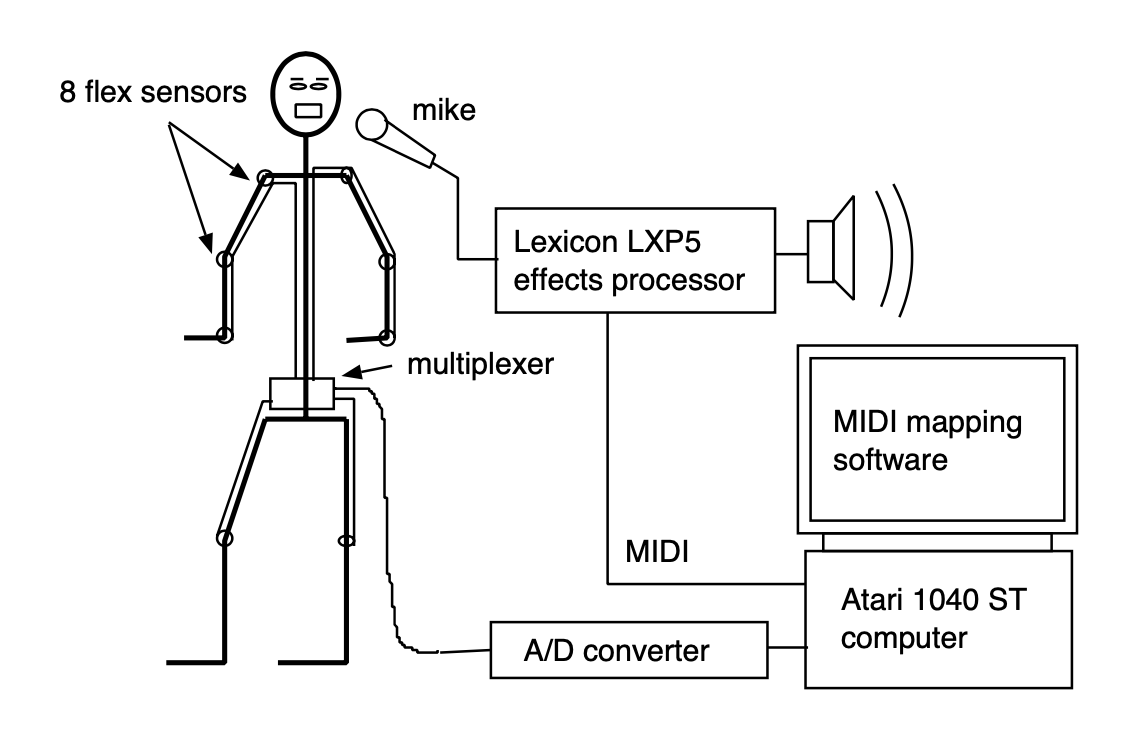
The system used to generate the effects during the dream consisted of a body suit equipped with sensors that measured joint angles, custom analog to digital conversion hardware with serial data output (similar to an I-CubeX digitizer that I would develop a couple of years later), an Atari 1040-ST computer running custom signal processing and mapping software, a Lexicon LXP 5 effects processor and a voice mike, see the diagram below.
For the suit I used the same technology as in the glove that I made. There were 8 bend sensors from a PowerGlove (similar to I-CubeX BendShort sensors) that were attached to the wrists, elbows, knees and ankles. They controlled in real-time the Lexicon LXP 5 effects processor that processed Egmont's voice.
Rob Baaima helped out in mapping the joint angle values to the LXP 5 parameters. The LXP 5 was quite sophisticated in terms of real-time control, although certain parameter value combinations could choke it, so that clicks or other unwanted effects would arise.
Each of Egmont's joints was directly mapped to a parameter of the LXP 5. It was quite difficult to learn to "play" the system, since such a mapping doesn't allow the performer to conceive of the system using "natural interaction metaphors". Such natural interaction metaphors are hard to find when designing such a new form of musical instrument, since there is no proper precedent, in terms of behaviours that he already knew, for the performer to rely on.
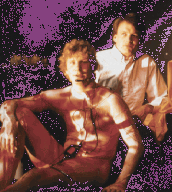 Egmont Zwaan in the pink suit.
I'm sitting in the back.
Egmont Zwaan in the pink suit.
I'm sitting in the back.
Just before I came to Canada to do my PhD and further develop this concept of Virtual Musical Instruments I gave a party (.. what's new ..) and "performed" with the suit. I simply played a CD through the LXP 5, used the same setup as with Egmont and made some moves. Unfortunately, since there were so many people in a relatively small space, it was very humid and the sensors (since they are high-impedant) were bypassed by skin resistance, swet etc., i.e. the effects were rather uncontrolled (as it should be during a party ...).
After arriving in Canada I attended the SFU Computed Art Intensive, which is held every summer. I worked with Mari Kimura in a piece called "Axel's Length" (yes, I am tall - 6ft5 or 1m95) that involved her violin playing, me as a dancer and Anita Cheng as a dancer. We used only two sensors to control a Lexicon LXP 1 (slightly less capabilities than the LXP 5).
This page was created in 1995 and last updated on 17 Aug 2022.